Showing posts with label tradition. Show all posts

Tuesday, 15 January 2013

Святки - Christmas Days

Svyatki - Святки (saints, holidays, winter holidays, holy days) - twelve days of Christmas - Рождество (Christmas tide) to Epiphany - Крещение. All the days are filled with amazing joy of Christmas.

picture from the animation 'Christmas Eve' (1951) based on the story of N.Gogol

From the interview with priest Alexander Ilyashenko, (father of 12 children and grandfather of 31 grandchildren) These days are ideal for devoting it to friends, family, children and parents, and those lonely people who have no family. "Behold what is good or what is nice, but let brothers live in peace" - says the prophet David.

Christmas - is a children's holiday, and the joy of these days will pass on to children. How subtly noticed Dostoevsky, even if life unfold person in the other direction, in a difficult moment, as an inspiration, it will stir childhood impression and it turns out to be life-saving - it will help to make the right decision.

«Знайте же, что ничего нет выше, и сильнее, и здоровее, и полезнее впредь для жизни, как хорошее какое-нибудь воспоминание, и особенно вынесенное еще из детства, из родительского дома. Вам много говорят про воспитание ваше, а вот какое-нибудь этакое прекрасное, святое воспоминание, сохраненное с детства, может быть, самое лучшее воспитание и есть. Если много набрать таких воспоминаний с собою в жизнь, то спасен человек на всю жизнь». (Ф.М. Достоевский «Братья Карамазовы»).

Orthodox Christians at Christmas have always tried to find time for charity. These days, are perfect for sharing the joy of Christmas with the people of Christ, making them something good. Many people attend these days hospitals, orphanages, organize Christmas concerts, congratulations.

Traditionally, looking back to ancient times, we learn that this holiday had a lot of entertainments, not all of them are still popular.

People used to say about this period:
  • At Christmastime wolves marry. На Святках волки женятся 
  • From Christmas to Epiphany to hunt animals and birds sin - the hunter misfortune happens. От Рождества до Крещения охотиться на зверей и птиц грех — с охотником несчастье случится  
  • Christmas passed, sorry to separate, Shrovetide comes  - tie to ride" - «Прашли Святки, жаль расстаться, пришла Маслина — кататься» (воронеж.).
Mythological significance  of Christmastide determined their "borderline" character - this time the sun turns from winter to summer, daylight moves from darkness to light, the old ends and a new year is born the Savior of the world, and chaos followed by divine ordering.

These days are also perfect for caroling - колядование

Carol ( Kalyada, Koleda,- Коляда) - traditional celebration of the Slavic people, associated with the winter solstice, and later dedicated to Christmas and Christmas time. Inherent attributes of the holiday is changing - ряжение (mummers using skins, masks and horns), caroling, Christmas carols songs, bestowing, youth games, fortune telling.

Here is a nice episode of caroling on Christmas Eve of the famous story by Nicholay Gogol 'Christmas Eve' - "Ночь перед Рождеством"


Here is one of the most famous carols, 


And in Jerusalem early ringing
Rejoice, rejoice  earth, the Son of God's was born

Come marvel at the star of the Miraculous
Rejoice, rejoice but earth, the Son of God's was born 

How to sing it


Text is below 


А в Иерусалиме рано звонили, 

 А в Иерусалиме рано зазвонили
Радуйся, да радуйся земле, Сын Божий народися
Выйди подивися на звезду чудесну
Радуйся, да радуйся земле, Сын Божий народися
Звезда возсия над вертепом ста
Радуйся, да радуйся земле, Сын Божий народися
Трём царям дорогу в вертеп показа
Радуйся, да радуйся земле, Сын Божий народися
Цари приидоша дари принесоша
Радуйся, да радуйся земле, Сын Божий народися
Имут бо приити три праздника в гости
Радуйся, да радуйся земле, Сын Божий народися
Первый убо праздник - Рождество Христово
Радуйся, да радуйся земле, Сын Божий народися
А вторый же праздник - святого Василия
Радуйся, да радуйся земле, Сын Божий народися
А третий же праздник - святое Крещение
Радуйся, да радуйся земле, Сын Божий народися
И на этом слове бывайте здоровы
Радуйся, да радуйся земле, Сын Божий народися
Христос Бог народися 

Friday, 7 December 2012

ХЛЕБ ВСЕМУ ГОЛОВА - BREAD IS THE STAFF OF LIFE


People in different parts of the globe start their day with a breakfast bread. In the past, the rules of composition and bread were a real family secret. There are families who still hold their own recipe. As its role was significant, there are a lot of customs and rituals connected with bread.


The Russian word 'KHLEB' – хлеб comes from old-slavic form *xlěbъ which is a loan word from old-germanic герм. *xlaiƀaz. Being a chief food in many cultures, it is considered as a source of life and symbol of labour
According to the Slavic hospitality traditions, round bread with salt cellar in the middle of the loaf ('bread-and-salt' tradition) on the embroidered towel is presented to dear guests.

In Christianity bread plays an important role during the Liturgy when celebrate the Eucharist, a rite derived from the narrative of the Last Supper when Jesus broke bread with his disciples

The Lord's Prayer, for example, contains the line "Give us this day our daily bread"; here, "bread" is commonly understood to mean necessities in general.

As for the types of bread, we should mention The karavai (каравай) is a traditional Ukrainian and Russian bread, most often used at weddings, where it has great symbolic meaning, and has remained part of the wedding tradition in UkraineRussiaBelarus.

The bride and groom were given the  karavai as a blessing before the wedding ceremony. The  karavai was shared by all the wedding guests, and this was considered the culmination of the wedding.

    Some  types of bread products
    1. lavash

    5. lepeshka
    2. kalach
    6.  kolobok 
     
    3. plushka
    7. karavay 
    4. pechenie 
    8. vatrushka
    9. sukharik
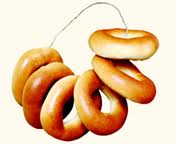
    10. bublik

    11. bulka


    12. pryanik

    13. pirozhok

    14. krendel
     
    15. kalitka

    16. bukhanka \ 'black bread'
    17. baton\ 'white bread'
    18. khala

    19. black 'round' bread

The process of making bread is far from being easy. Besides, it requires special attitude. For example, some people who bake bread told me that you should love it, talk to it while preparing and never start doing it being angry or irritated – otherwise you won't manage. Still if you are ready to this deed, you may use one of the following recipes – to enjoy home-made fresh delicious and healthy bread!

One of the basic recipes of bread in oven

You'd need 30 grams of yeast; 50 grams of sunflower oil; 50 grams of margarine; 1 egg; 80 grams of sugar; salt; flour.
To prepare the dough , take 20 grams of yeast, add some salt, sugar, 0.6 liters of milk and flour, then the softened margarine and oil. The dough should not be too thick, so control the amount of the flour, Properly mix it, knead, and leave the dough in a warm place for 12 hours.
0.7 liters of boiled cool milk; Then add the remaining milk, yeast, salt and flour and stir well. On a greased baking sheet lay out the dough for half an hour or more, to make the dough 'come'. Then make the loaves of dough and bake in the oven until lightly browned 

more recipes here

Some idioms about BREAD

1) as for the kind of bread
чёрный хлеб — brown bread, rye bread
бе́лый хлеб — white bread
дома́шний хлеб — homemade bread
чёрствый хлеб — stale bread
све́жий хлеб — fresh-baked / newly-baked bread
хлеб с ма́слом — bread and butter
сажа́ть хлеб (в пе́чку) — put the bread into the oven

2) colloq.'bread' in the meaning 'living; means of subsistence', daily bread
зараба́тывать себе́ на хлеб — make one's bread, earn (ɜːn) one's living
лиши́ть кого́-л куска́ хлеба — deprive smb of a livelihood
отби́ть у кого́-л хлеб — take the bread out of smb's mouth

Some set phrases

  • хлеб да соль! (hleb da sol', 'bread and salt')— 1)enjoy your meal! 2) welcome!
  • хлеба и зре́лищ! — (give us) bread and circuses!
  • хлеб наш насу́щный дай нам на сей день (даждь нам днесь уст.) библ. — give us this day our daily bread
  • его́ хлебом не корми́ - (то́лько) дай (+ инф.)  — there's nothing he likes better than (+ ger)
  • да́ром хлеб есть — ≈ not to be worth one's salt
  • и то́ хлеб — that's at least something; that's better than nothing
  • не хлебом еди́ным жив челове́к библ. — man cannot live by bread alone
  • (от)пуска́ть хлеб по во́дам библ. — cast one's bread upon the waters
  • перебива́ться с хлеба на во́ду / квас — ≈ live from hand to mouth
  • посади́ть на хлеб и во́ду кого́-л — put smb on bread and water
  • э́то наш хлеб — it's our bread and butter


Sources
wikipedia
main photo from www.vk.com, group 'Воины света'

Sources of photos 
1. http://produkti-online.ru/engine/glossary/armyanskii_lavash.html, 2. http://www.oao-zhk.ru/bulka.html, 3. calorizator.ru, 4.http://kuharka.com/rassypchatoe-pechene-recept.html, 5. moikompas.ru, 6.skyclipart.ru, 7. chenonceau.ru, 8. calorizator.ru, 9. fitfan.ru, 10.24open.ru, 11. gotovim-doma.ru, 13. moikompas.ru, 14. recepty1.ru, 15.texnologi-omut.ucoz.ru, 17.nnm.ru, 18.http://kuharka.com/xala.html, 

Wednesday, 9 May 2012

Songs of Victory

Here are some songs that symbolises the Victory Day, the 9th of May. Some were helping the warriors to fight against the enemy through all those terrible years, some were 'born' later, created for films or events, but also has become the sounds of this Great Day Темная ночь - Dark night Listen or download Марк Бернес Темная ночь for free on Prostopleer День Победы - Victory Day Listen or download Лев Лещенко День Победы for free on Prostopleer За того парня - For that guy Listen or download Лев Лещенко За Того Парня for free on Prostopleer Бери шинель, пошли домой - Take the overcoat, let's go home Listen or download Бери шинель, пошли домой for free on Prostopleer Песня из кинофильма "Офицеры" - song from the film 'Officers' Listen or download Песня из Кф <<Офицеры>> for free on Prostopleer Прощание славянки - Farewell song of a slavonic girl Listen or download Военные песни прощание славянки for free on Prostopleer

Saturday, 5 May 2012

The Victory Day is coming soon

Soon comes the great holidayer our country. The campaign 'Georgian ribbon' has started, the soldiers practice before the parade on Red Square, and we remember and respect those who made us a great gift - our lives and freedom!


from vk.com

Monday, 16 April 2012

Easter holidays, family and country traditions. Photo-report

Happy Easter! This is a phrase that we may repeat every day this week and next 40 days.
WE already discussed the traditions for Easter, what and how to prepare and to cook,

Now let's see some results!


Painted eggs and kulich
by talented designer and photographer Oksana Podgorodetskaya aka vinsa and her family (Moscow)

Easter baskets and kulich


by Russians from Hong Kong (photo by Kira Pozdnyaeva)

The eggs from the festival 'Living Art' ("Живое искусство") in Moscow in Lavrushincky pereulok, near  the Tretyakov Art Gallery


more photos from the festival

Sunday, 15 April 2012

Happy Easter! Christos Voskrese!

Today the Orthodox world celebrates Easter. In Russia the priest says 'Christos  Voskrese', all people answer 'Voistinu Voskrese', which means 'Christ is risen' - 'Truly is risen'

And here is an Easter basket of Easter 2012 from Kira Pozdnyaeva (Hong Kong)


Христос Воскресе! 
基督复活了 
Kristus nousi kuolleista! 
Le Christ est ressuscité! 
Christ is Risen!


Tuesday, 10 April 2012

Preparing for Easter. Decorating eggs, creative ideas

We continue speaking about the ways to decorate the eggs for Easter. Now let's see some hand-made variants

1. LACE and ELASTIC band (by Anna Golub).

  First cook hard-boiled eggs.

  Then mix 4 tablespoons of vinegar with 12 drops of blue food dye, and 2 cups of hot boiled water.
  Wrap the egg with lace cloth and fix it with elastic lace on the egg.
  Using a spoon, dip the egg into the vinegar first, then into the dye.
  Allow the eggs to dry.

2. Using punch and coloured paper (by Anna Golub)


For this method of dyeing eggs we need various leaves (parsley, coriander, basil), the old nylon stockings, thread, and onion peel (for the main colour). 

Fix leaves with a piece of nylon, carefully remove after coloring.


4. Decorate Easter eggs with beads and strass (from the member of the community).

Glue strips of double-sided tape to the egg. Sprinkle with colored sand for needlework. Shake off extra sand. 
Glue the tape for the stripes of another color. Sprinkle with sand, shake off extra sand.
Put a layer of the acrylic lacquer spray to the egg.
 
Instead of colored sand you can take beads or strass. Glue them with silicate glue randomly or make a particular pattern. The easiest way to draw stripes, crosses and flowers. 


Preparing for Easter. Decorating eggs, natural colours

You all may already know that in Russia we also are fond of decorated or painted eggs for Easter. We cook and decorate them in advance, then bless in the church and after that eat, give as present or 'play' with it. You may read about this traditions and about the history of the 'Easter egg' in one of our older posts.

In Russia Easter eggs were put over fresh green oats, wheat, and sometimes pale green tiny leaves of watercress, which are specially pre-germinated for a holiday.

As was the custom to keep the eggs during the whole year until next Easter, later eggs were made of wood and painted with ornaments and designs. Also there appeared  eggs made of porcelain, silver and precious stones.

Today I will show you the ways you may decorate the eggs. The ideas are taken from very nice community 'Leisure of orthodox children' and from the web-site www.kuking.net

1. The most traditional way is to paint them with onion peel

Collect the peel in advance. Depending on the color of peel the color of eggs may vary from light red to dark brown. If you want the color was more saturated, you must take more peel, and boil it for half an hour before you put the egg into the 'broth'. Almost purple colour for eggs is obtained from the peel of red onion.

In order that the eggs do not burst during cooking,  hold it for an hour in  a warm place; when boiling in the water add a tablespoon of salt.

2. Some other natural colours for the eggs

 gilding
 Add to hot water 2.3 tbsp turmeric, boil, so that the color was more intense.

  pink
  Soak cooked eggs in beet juice, or cranberry.

  purple
  Add flowers of violets to the hot water and soak overnight. If you add the water a drop of lemon juice, you get the color of lavender.

  green
 boil the eggs with spinach.

  lavender
  Soak eggs in grape juice.

  Umber
  Boil the eggs in 250 ml of coffee.

Sunday, 8 April 2012

Easter is coming soon, time to prepare! Cooking 'Paskha'

Happy Easter to all friends who celebrate it today! Easter (or as we call it Paskha - Пасха) for Russians, who are mostly Orthodox Christina, comes next week, on Sunday, the 15th of April.

As for the Easter traditions, you might remember the post about traditions in Russia. You may also refer to the post about the Easter postcards and congratulate your orthodox friends with a beautiful vintage Easter postcard.

Let's see what and how do we cook for this kind spring holiday.

1. Paskha, cottage cheese (tvorog, творог) cake or curd
2. Kulich, or Easter cake
3. Painted eggs

Usually all cooking starts on Thursday. Then on Saturday the food it taken to the church to be blessed. And on Sunday it's time to eat all that!

Let's see how to cook no.1, Paskha


Пасха - Paskha is a kind of curd made of cottage cheese, eggs, sugar etc which is cooked once in a year - only for the fest of Resurrection. It's original shape is cut pyramid, that's representing the Tomb of Christ. Together with other traditional dishes, Paskha is taken to the church on Great Saturday and is blessed. You may eat it when the Great Lent is over, on Sunday - the day of Resurrection.

Indeed there are many ways to cook it as well as to cook the cottage cheese itself, but here is one of the recipes.
the recipe is taken from gotovim-doma

Ingredients

cottage cheese (fat) - 500 g,
Eggs - 2-3 pieces,
sour cream - 200 g,
Powdered sugar - 70-100 g,
butter - 100 g, candied fruit, almonds, raisins

Preparation


Rub Cottage cheese through a sieve or twice through a meat grinder.
Put on a little thick-fire pan and melt the butter in it. When the butter is soft, add cottage cheese and stir until the mixture becomes more liquid. Then add sour cream and mix well carefully. At the very least add the eggs one at a time and stir until smooth mass.

Cook on low curds heat, stirring constantly to avoid burnt. Once the mass begins to boil, remove the pan from the heat and put on ice or in cold water, and stir to cool.
Add powdered sugar and vanilla sugar.

Prepared mass is put into the pasochnitsa (it's a kind of a bowl whith s special shape, that will make the shape of your future cake) which is moisten with water and laid with cotton towel. Fold the edges of cloth, put the oppression on it, and put into a cool place not less than for 12 hours.


When ready, Easter cake is carefully extracted from pasochnitsa, bend the edge of the napkin and put it on a dish. Decorate Easter with candied fruits, raisins and marmalade.

Traditional decorations are letter ХВ, first letters from the phrase Христос Воскресе which means 'Christ is risen'; and three-bar cross


There are many other variants of its taste, like Easter with condensed milk, Easter with almonds and raisins, Easter with pistachios, Easter with cocoa, Easter with pumpkin,  Easter in sweet custard etc

Monday, 27 February 2012

Pancake week, Forgiveness Sunday and the Great Lent

The last week was a week of Maslenitsa or Pancake week, you could learn about it in the post earlier. Each day of the week has its own name and traditions. Usually Russians visit each other during the whole week and cook and eat a lot of pancakes.
The pancake week's last day - Sunday - is so called Forgiveness Sunday. On this day there is a very kind tradition - we ask for pardon and forgive each other for all evil and wrong things we have done to each other. In such a way you 'become clean' from all your sins - when you receive an excuse and forgive those who did wrong to you.

In Russian we use to say the following
- Прости меня! - Forgive me 
- Бог простит, и я прощаю, и ты меня прости! - God forgives you and I will forgive, please forgive me too! 


Next day after the Forgiveness Sunday in Orthodoxy comes the Great Lent, the fasting time before the Easter which lasts 40 days and the Passion week.


Clean Week

The first week of Great Lent starting on Clean Monday, the first day of Great Lent. The name "Clean Week" refers to the spiritual cleansing each of the faithful is encouraged to undergo through fasting, prayer.
Throughout this week fasting is most strict. Those who have the strength are encouraged to fast completely, eating only on Wednesday and Friday evenings, after the Presanctified Liturgy. Those who are unable to keep such a strict fast are encouraged to eat only a little, and then onlyxerophagy (uncooked food) once a day. Meals are served on Saturday and Sunday, but these are fasting meals at which meat and dairy products are forbidden.
At Great Compline during the first four days of the Fast (Monday through Thursday) the Great Canon of St. Andrew of Crete is divided into four parts and one part is chanted each night (for further information about the Great Canon, see Fifth Week, below).
The First Saturday is called "St. Theodore Saturday" in honor of St. Theodore the Recruit, a fourth century martyr. At the end of the Presanctified Liturgy on Friday (since, liturgically, the day begins at sunset) a special canon to St. Theodore, composed by St. John of Damascus, is chanted. 
The First Sunday of Great Lent is the Feast of Orthodoxy, which commemorates the restoration of the veneration of icons after the Iconoclastcontroversy, which is considered to be the triumph of the Church over the last of the great heresies which troubled her (all later heresies being simply a rehashing of earlier ones).
(c) wikipedia